 BLACK FOREST
The Two
Places
- 00Foreword: The Study That Said No
- 01The Dose on the Back of the Bottle
- 02Two Places, One Checkup
- 03The First Place: The Wall
- 04The Second Place: What Forms Inside
- 05The Amount Nobody Questioned
- 06The Cocoa Question
- 07What You Can Do Now
- 08Before You Add Anything
- ·The Receipts & Disclosures
The Study That Said No
In 2021, researchers at USC ran the kind of study you should trust. They took 265 healthy adults, median age sixty-five, and for three years gave half of them an enzyme and half a placebo, double-blind, nobody told which was which. At the end they measured the arteries, the stiffness, the blood pressure, every lab value on the sheet. Nothing moved. The headline wrote itself. It does not work.
Read the paper and a smaller thing is sitting in plain sight. The study tested one amount, and it tested it in people who were already at low risk, the group with the least room left to improve. A no in the easiest case is not a proof that the thing is useless. It is one careful answer to one narrow question, and the question was not the interesting one.
This guide is the part you were never handed. Not a pitch, a map. What a heart attack is actually decided by, the two places your yearly checkup never opens, and the honest state of the evidence on each. By the last page you will be able to read a cocoa label the way a chemist would, read an enzyme study the way its authors meant it, and ask your doctor a sharper question than the one printed on the form.
I sell supplements for a living, so read all of this with the suspicion that deserves. There is nothing to buy in these pages. No product is named, no dose is given, nothing here needs your card. What you can learn without us is exactly what I want you to have. Let me show you the two places, and then let the evidence say what it honestly says.
To your health,
Antonio Colmenares
Founder, Black Forest
The Dose on the Back of the Bottle
Scroll the best-seller list and nattokinase looks like a crowded shelf of choices. Different brands, different bottles, different promises on the front. Turn each one over, though, and read the one line that decides everything, the activity printed on the back, and the choices collapse into a single number. Here are the eight best-sellers in the United States, pulled from the two largest shelves there are. Reveal what is printed on each.
Two thousand units. Eight of the eight. It is not a coincidence and it is not a conspiracy. It is the amount the first widely cited studies used, and almost every bottle since has copied it, the way a whole shelf ends up carrying one spec because the first one did. A few newer bottles double it to four thousand. Even those sit far below the amount used in the single study that ever went high, and that study, as a later chapter shows, was not the kind you can lean on.
Hold the number 2,000 in mind. In the foreword, the three-year study that found nothing tested exactly that amount. The question this guide keeps returning to is not whether the enzyme is real. It is whether anyone has honestly tested enough of it.
Two Places, One Checkup
The number is supposed to be the all-clear. Your cholesterol comes back under one hundred, the level the guidelines have called optimal since 2001, your blood pressure reads normal the morning of the visit, and you leave believing the matter is settled. For a great many people it is not.
The largest look at this is hard to argue with. Researchers pulled the hospital records of heart-disease admissions across the country and read the cholesterol on every chart where it was written down, more than 136,000 of them. The average was about 105. Almost half of the people who arrived in a cardiac bed had walked in with an LDL under 100, the number their chart would have called optimal. Their number was fine. Their heart was not. Turn the lab sheet over and see what it never checked.
The first place is the wall of the vessel itself, a thin living surface that actively decides whether blood flows easily or forced. The second is what forms inside the vessel, the clot that seals a torn plaque and closes the pipe. A reading on a lab sheet measures neither of them. Turn the page and we will open the first.
The Wall
The discovery was almost an accident. Brooklyn, 1980: a pharmacologist named Robert Furchgott could not get his artery preparations to relax, and the reason turned out to be that the delicate inner lining had been rubbed off during handling. Leave the lining intact and relaxation returned. The lining was releasing a signal. That signal was nitric oxide, and in 1998 three scientists shared a Nobel Prize for it. Your vessels are not passive tubing. They are a surface that opens itself, on a molecule it manufactures on the spot. Tap through the wall and see what it is made of.

And the signal fades. Work out of Pisa followed the response as people aged and found that the vessel's ability to widen on its own declines over the years, the wall growing quieter with time. Drag the years and watch it.
There is one group where the wall almost never gives up, and it points straight at what keeps it open. A team working out of Brigham and Women's in Boston studied 316 Kuna, the island people of Panama. On the islands, blood pressure barely rose from the twenties into old age. The very same people who moved to Panama City lost it: their pressure climbed with age like everyone else's. Same genes, different place. The islanders also drank about ten times as much cocoa. Follow how the pieces were found.
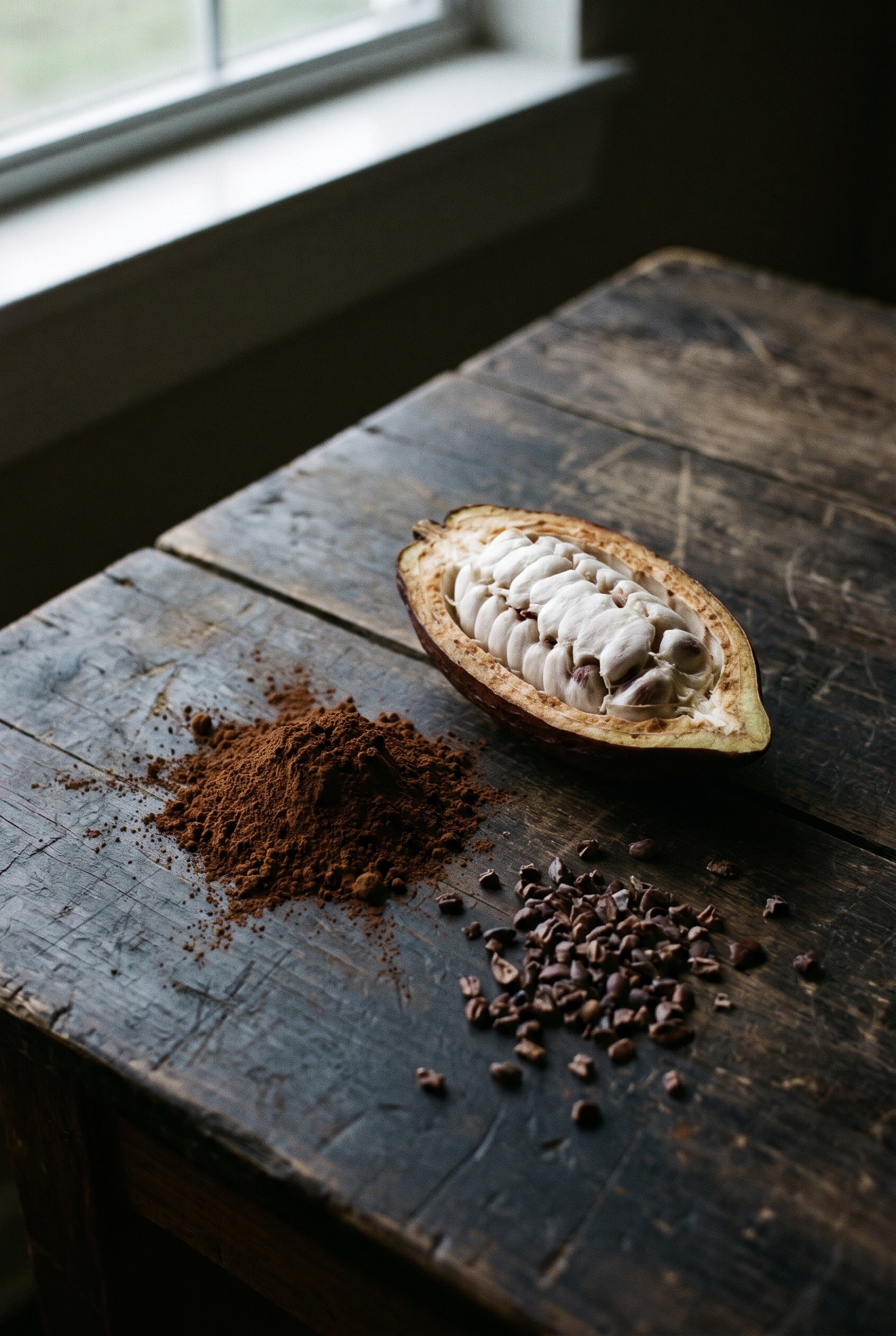
Why would cocoa touch this exact place? Because of one part of it, the flavanol. In Boston, volunteers given flavanol-rich cocoa for five days showed striking widening of their vessels, and when the researchers blocked nitric oxide, the effect vanished completely. A later study raised circulating nitric oxide and vessel function with flavanol-rich cocoa, and purified epicatechin, the main flavanol, did much the same thing on its own. The flavanol speaks to the wall through the very signal Furchgott found by accident. Several of these studies had co-authors from a chocolate company, and the references say which.
What Forms Inside
A heart attack does not usually finish the way people picture it, as a slow pipe finally closing. Most begin in an instant, when a plaque in the wall tears and the blood does what blood is built to do, sealing the tear with a mesh of fibrin. The mesh is the clot, and the clot closes the vessel. Step through how it happens.
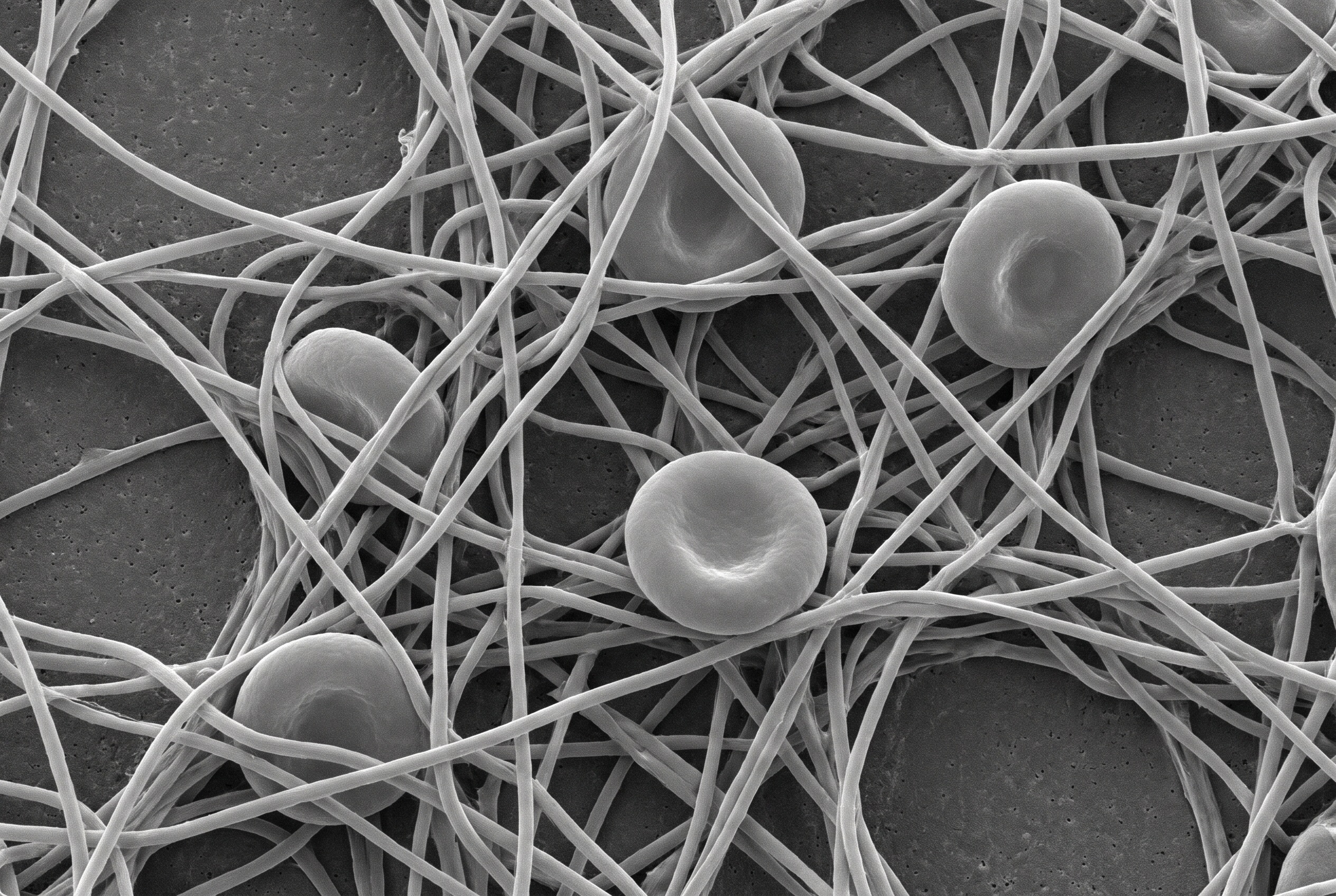
Your body builds that mesh on purpose, and it is also built to clear it, through a system called fibrinolysis that slows with age. Which brings us to a Japanese laboratory in 1987. A researcher named Hiroyuki Sumi was screening foods for anything that would dissolve fibrin in a dish. He went through 173 of them. One did it, and it did it fast. It was natto, the fermented soybean dish Japan has eaten at breakfast for a thousand years, and the enzyme responsible he named nattokinase. That is the enzyme from the foreword, named now for the first time.
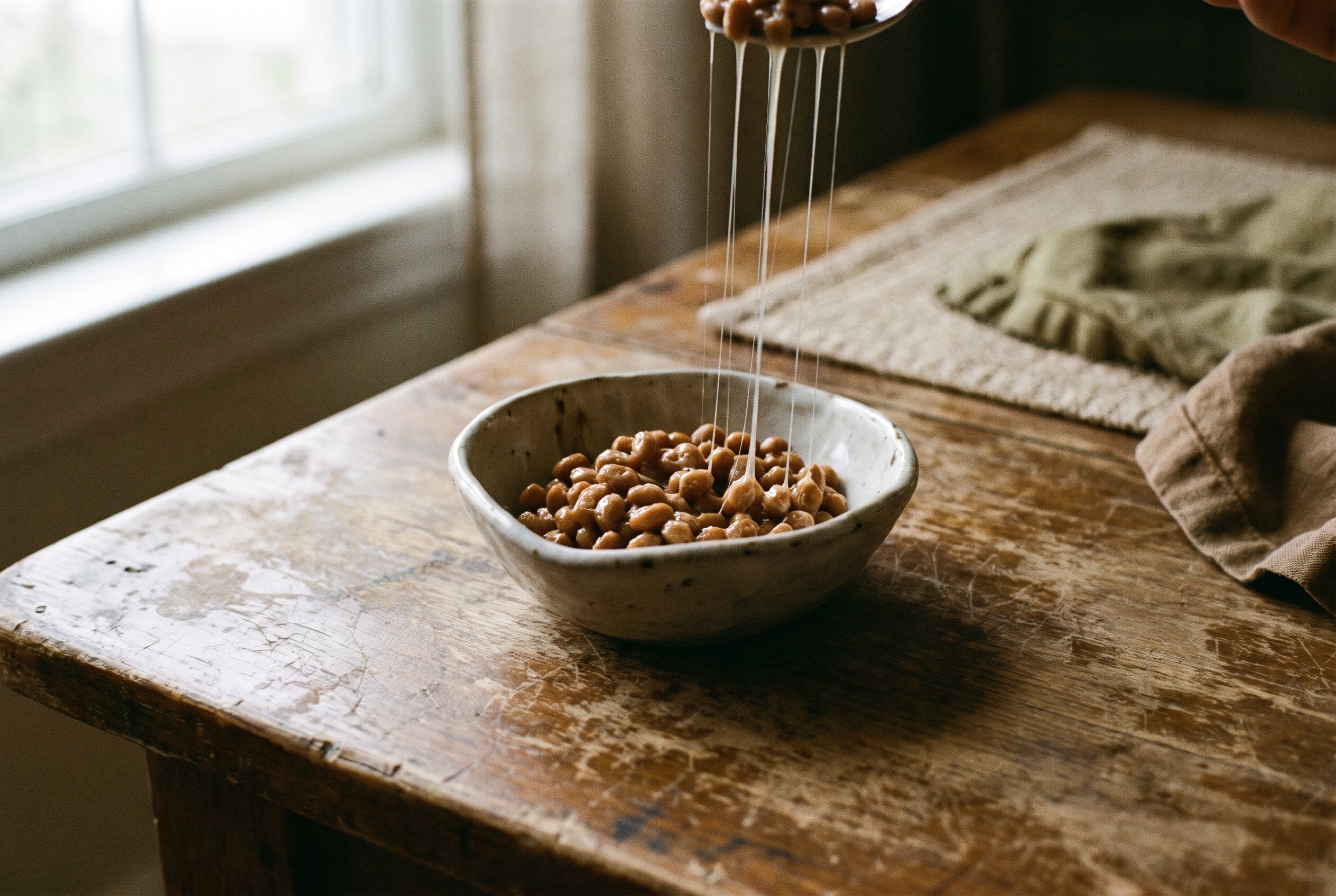
The backdrop makes the point land. Japan's cardiovascular death rate is about half the United States'. One country opens the day with the thing that dissolves fibrin. One country has, by and large, never heard of it.
Two countries, one cause of death
Line the two rates up and the gap is not subtle. These are age-adjusted deaths from cardiovascular disease, the broad category heart attacks fall inside. Reveal the bars.
A difference that large has many causes, and no honest guide would pin it on one food. But the one food sits at the center of the second place, and that is enough to ask the next question: if the enzyme does something, how much of it does it take? The careful answer is the next chapter, and it is not the answer the headlines gave you.
The Amount Nobody Questioned
Return to the null from the foreword. Three years, 265 low-risk adults, one amount of the enzyme, and nothing moved. Taken alone, it reads like a closed door. Put the other careful studies next to it and the door looks different. A randomized trial in 2008 gave the same amount for eight weeks and saw blood pressure fall by roughly five and a half over two and a half points. A crossover study in 2015 gave twelve young men a single dose and watched the markers of clot breakdown rise within hours while clotting factors eased, every change staying inside the normal range. Something happens. It is quiet, and it is real. Tap each study.
Notice the number all of those careful studies share: the same amount, roughly 2,000 units. It became the standard by repetition, not because anyone ran the experiment to see whether it was enough. One study looked higher, and how you read it is the whole lesson in reading evidence. Turn it over.
So the honest state of the evidence is not an answer. It is a question: what if the careful trials, the ones that found little, simply tested too little?
This guide cannot answer that for you, and it will not pretend to. What it can do is make sure that the next time you read "studies show it does not work," you know which studies, at what amount, and in whom.
The Cocoa Question
The flavanol is the part of cocoa that speaks to the wall. It is also the part that is easiest to destroy and easiest to hide, which is why a box of cocoa tells you almost nothing about whether it will do a thing. The first way the flavanol disappears is in processing. Alkalized cocoa, listed as "dutched" or "processed with alkali," is darker and smoother and stripped of most of its flavanols.
The second way the flavanol disappears is simpler: most cocoa prints no flavanol number at all. A powder doing the work would have no reason to hide the single number that decides whether it does.
Then there is the metal. In 2023, Consumer Reports tested 48 chocolate products and found lead or cadmium in every one of them, with sixteen of the 48 above the level the magazine flags as a concern. Cocoa pulls metals out of the soil, so the only honest answer is to test each lot and show it. Put the two together and you have a simple test for any cocoa.
And the biggest trial of cocoa? Read it straight, not from the headline.
In 2022 a study gave more than 21,000 adults a 500-milligram cocoa-extract capsule for about three and a half years. The main result, total cardiovascular events, did not reach statistical significance. A secondary result, death from cardiovascular causes, was about 27 percent lower. A genuine signal and an honest caveat in one sentence, which is more than most labels give you.
None of this faults cocoa. It faults the two powders sharing its name, and it hands you the test to tell them apart: a flavanol number on the label, and a metal certificate behind it.
What You Can Do Now
You now know the two places a heart attack is decided, and you know your yearly number looks at neither. Here is what to do with that, split into what you can act on and what you can ask.
For the wall
The signal the wall runs on answers to how you live, and it declines faster in a body that sits than one that moves. Move most days, in whatever form you will keep doing. When you reach for cocoa, reach for the one that proves its flavanols by the test you just learned, the printed number and the metal certificate, not the one that hides them.
For what forms inside
The clearing system slows with age, and the country that eats the clot-dissolver at breakfast buries half as many of its people. You cannot eat natto if you will not eat natto, and most of us never will. Hold that gap in mind rather than filling it with the first thing a label promises.
Questions worth bringing to your doctor
Beyond my cholesterol number, is there anything you can tell me about the lining of my vessels, the first place? Is there any way you look at how well my blood clears a clot, the second place? Your doctor can tell you honestly whether and how either one is ever measured.
One caveat, because this guide lives or dies on it: I am still reading the primary research behind every general habit, and I will not hand you a number I have not checked myself. What is in this chapter is only what the evidence already in this guide supports, and nothing more.
Before You Add Anything
This guide is about two places and the evidence that speaks to each. It is not a protocol, and this chapter is the single most important reason it is not.
A clot-dissolving enzyme and a blood-thinning medication push in the same direction by different routes, and doing both at once can push too far.
Published case reports describe bleeding when nattokinase was taken alongside anticoagulant or antiplatelet medication. If you take a blood thinner, aspirin included, or you have a bleeding disorder, or you are heading into surgery, or you are pregnant, do not add a fibrinolytic enzyme on your own. Talk to your doctor first.
That is the whole warning. Not a dose, not a schedule, not a plan. A line you should carry before you read the next thing we send, and before you buy anything from anyone, this company included.
Move most days, and when you drink cocoa, drink the one that proves its flavanols. Both places, started, at no cost.
Ask the two questions. Put the wall and the clot on the table, and learn whether your checkup ever looks at either.
The wall and the clearing system both answer to how you live, over months, not days. The lever was always there. Now you know where it is.
Be first when it lands.
This guide was the gift, and it stays free whether you ever hear from us again. We are building one thing for both of these places, a limited run, with the printed number and the certificate this guide taught you to demand. No name yet, no dose, nothing to buy today. Leave your number and we will text you the moment it is ready.
By tapping the button you agree to receive recurring automated marketing texts from Black Forest at this number. Consent is not a condition of purchase. Msg and data rates may apply. Reply STOP to cancel, HELP for help. We never share your number.
Prefer the web? Add your name on the early-access page ›
The Receipts
- NCEP ATP III (2001), NHLBI. LDL cholesterol under 100 mg/dL classified "optimal."
- Sachdeva A, et al. Am Heart J 2009 (UCLA, Get With The Guidelines). Lipids documented in 136,905 coronary-disease hospitalizations; mean admission LDL 104.9; nearly half admitted under 100. Unit: hospital stays.
- Furchgott RF, Zawadzki JV. Nature 1980 (SUNY Brooklyn). The endothelium releases a relaxing signal, later identified as nitric oxide. Nobel Prize 1998 (Furchgott, Ignarro, Murad).
- Palmer RMJ, et al. Nature 1988. Endothelial cells make nitric oxide from L-arginine.
- Taddei S, et al. Hypertension 2001 (Pisa). Endothelium-dependent vasodilation declines with age.
- Hollenberg NK, et al. Hypertension 1997 (Brigham and Women's). Island Kuna blood pressure flat with age, urban Kuna's rises. "Not genes" is inferred from migration, not a genetic test.
- McCullough ML, et al. J Cardiovasc Pharmacol 2006. Island Kuna drank about ten times more cocoa. Mars co-authors disclosed.
- Bayard V, et al. Int J Med Sci 2007. Age-adjusted cardiovascular deaths per 100,000: mainland 83.4 vs San Blas 9.2; "an observational study cannot provide definitive evidence."
- Fisher NDL, et al. J Hypertens 2003 (Harvard/Brigham). Flavanol-rich cocoa caused striking vasodilation; blocking nitric oxide reversed it completely.
- Schroeter H, et al. PNAS 2006. Flavanol-rich cocoa raised nitric oxide and vessel function; pure epicatechin emulated it. Mars co-authors disclosed.
- Sumi H, et al. Experientia 1987. Nattokinase identified after screening 173 foods for fibrinolytic activity.
- Libby P. N Engl J Med 2013. Most heart attacks begin with a clot on a ruptured or eroded plaque.
- Japan vs United States. Japan's cardiovascular mortality is about half the US rate (Global Burden of Disease, 2019).
- Hodis HN, et al. Clin Hemorheol Microcirc 2021 (USC). 265 low-risk adults, 2,000 FU, about 3 years, no change; "null effect in healthy individuals at low risk."
- Kim JY, et al. Hypertens Res 2008. Randomized trial, 2,000 FU/day, 8 weeks; blood pressure fell about 5.55 over 2.84 mmHg.
- Kurosawa Y, et al. Sci Rep 2015. Single 2,000 FU dose; clot-breakdown markers rose within hours, within the normal range.
- Chen H, et al. Front Cardiovasc Med 2022. Retrospective, "not a randomized control trial"; about 1,062 people, higher daily amount, 12 months; tablets made by a company employing five of the authors, disclosed. No randomized trial has tested the higher amount.
- Miller KB, et al. J Agric Food Chem 2008. Flavanols: natural cocoa about 34.6 mg/g vs heavily alkalized about 3.9 mg/g.
- Consumer Reports, October 2023. 48 chocolate products; lead or cadmium in all; 16 of 48 above the level of concern.
- Sesso HD, et al. (COSMOS). Am J Clin Nutr 2022. 21,442 adults, 500 mg/day cocoa extract, about 3.6 years; primary endpoint not significant (HR 0.90); cardiovascular death, a secondary endpoint, about 27 percent lower.
- Bestseller label survey. US retail best-sellers on Amazon and iHerb, label activity read 2 November 2026: the eight top-selling nattokinase products each list 2,000 FU per serving; a few newer entrants list 4,000 FU. Brands held pending final review.
- Nattokinase safety. Published case reports of bleeding with concurrent anticoagulant or antiplatelet use. Consult a physician before combining.
- Nothing here contradicts an honest formula. This guide never faults cocoa, natto, the enzyme, or epicatechin for existing. It faults a processing step that strips the flavanol, a label that hides the number, a lot never tested for metals, and an amount made standard by repetition rather than proof. An honest, well-labeled ingredient passes every test in these pages.
This guide is educational and is not medical advice. It does not diagnose, treat, cure, or prevent any disease, including cardiovascular disease. The studies described are individual findings with their own limits, several with industry co-authors noted above, and none is a study of any Black Forest product. The on-screen illustrations are general and are not a measurement of you. Talk to your physician before changing your diet or supplements, especially if you take medication, have a bleeding or clotting condition, are pregnant, or are scheduled for surgery. Individual results vary.
Two Places
To your health,
Antonio Colmenares
Founder, Black Forest